The course, Reimagining Education for Equity: Interrogating Policy and Practice (REE), examines the role of education in sustaining social inequalities in India and deliberates how education can be transformed to empower teachers and students to attain an equitable, just, and sustainable future.



Courses
This 6-week self-paced course employs an analytical-normative-operational approach to demonstrate how cities can draw on new urban sciences to intervene most effectively in shaping their own future.
The 5-week self-paced course helps learners understand the why, when, what and how of economic policymaking through a combination of concepts and ideas, cases and examples and thought-provoking discussion questions.
If you are a researcher, academic, student, development sector professional or a practitioner who is keen to reach the research-based knowledge you have created to a wider audience, this course is for you.
This course offers a diagnosis of what housing justice looks like as well as the modes and practices that can move us towards it ranging from activism and direct action to public policy and participatory governance.
The course will be of value to anyone who is interested in learning about how cities function, the modern urban challenges that are emerging in the context of recent history and how these challenges can be addressed through a multidisciplinary approach.

SDI is a challenge for postgraduate and undergraduate students from Indian institutions to learn and design net-zero-energy-water, affordable and resilient design solutions for real, live projects to combat Climate Change through the buildings sector.
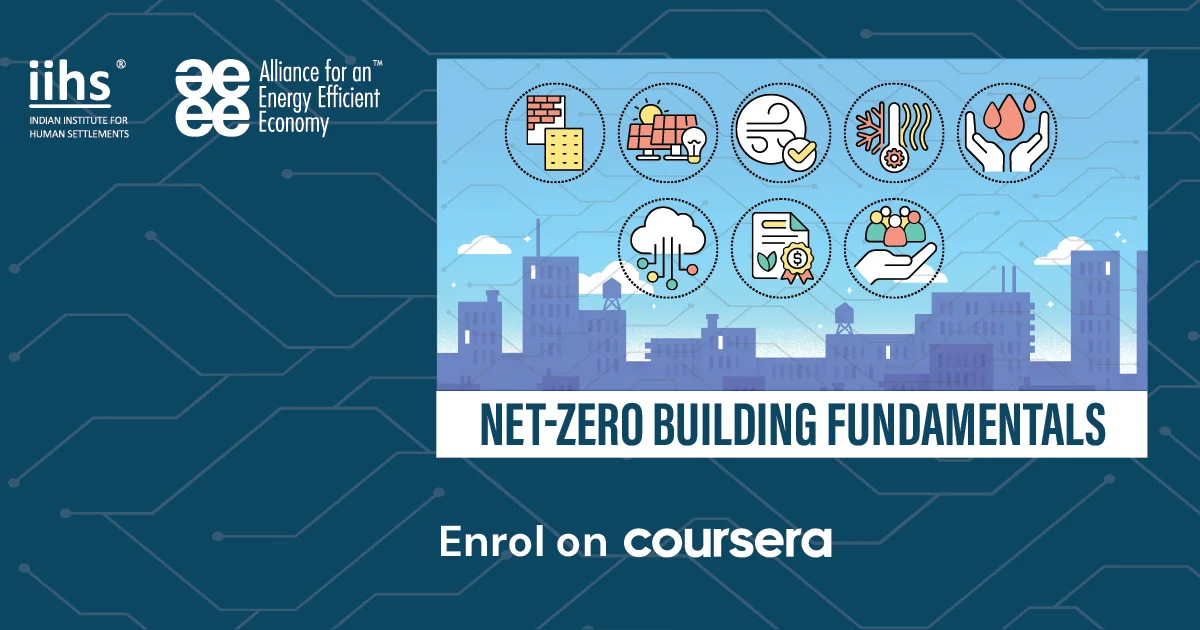
The online course, Net-Zero Building Fundamentals, will take you through the fundamentals of passive comfort, energy efficiency, renewable energy, and low carbon and resilient design for buildings.
The online course, Shaping Urban Futures: Working across Theory and Practice, draws on complementary research projects in places that will face the biggest challenges from rapid unplanned urbanisation to address interrelated issues such as economic growth, technological innovation, public health, climate change, migration and informality. SUF is a collaborative effort of five global institutions: the African Centre for Cities, Universidad EAFIT, Indian Institute for Human Settlements, University of Oxford and Peking University. The course will be relevant for all urban scholars, from early career researchers to veteran urbanists, across the government, the corporate, social and nonprofit sectors and academia.
Interested learners can enrol for the course on Coursera or on edX. Write to us at [email protected] for more information.
The online course, ‘The Art and Science of Economic Policy: A View from India’, is being jointly offered by IIHS Board Member Vijay Kelkar, along with his co-author Ajay Shah and Aromar Revi, Director, IIHS as Academic Director. This course enables citizens, public servants and learners to understand the implications of various aspects of governing a Republic. The course builds on intense research and reflection, and the faculty’s experience of more than 60 years as civil servants and professional economists in India. The course helps learners try to answer, among others, one key question: ‘What do we need to do to make our tryst with destiny?’
Interested learners can enrol for the course here or write to us at [email protected] for more information.
To help researchers, academics and development sector professionals reach their research work to a wider audience, IIHS has created an online course titled ‘Writing and Disseminating Grey Literature’. This is a six-module self-paced course, available on Coursera.
While research work like reports, working papers, government documents, white papers, evaluations, etc. are produced through a process involving rigorous research and fieldwork, there is a significant dearth of access to this knowledge among non-academic communities, including practitioners, policymakers and citizens. At the same time, newer platforms for knowledge dissemination across digital, print and multimedia channels have made information from grey literature more available and accessible to lay readers.
This course helps academics, researchers and development sector professionals who are keen to reach their new research-based knowledge and adopt newer writing techniques, such as data stories, photo essays, opinion pieces, map-based stories and infographics.
Interested learners can enrol for the course here or write to us at [email protected] for more information.
‘Housing Justice: A View from Indian Cities’ is a five-module self-paced course, hosted on Coursera. The course introduces learners to different approaches to thinking about housing justice, bringing together material, ecological, social and spatial approaches to thinking about housing.
This course offers a diagnosis of what housing justice looks like as well as the modes and practices that can move us towards it ranging from activism and direct action to public policy and participatory governance. The course helps learners to think in a particular way about known problems in housing, i.e., using a framework of housing justice. This new framing allows one to see the housing question in a different way that opens up different practice approaches and charts this journey from re-framing the problem and offering appropriate approaches to action.
Specifically, the course will benefit those who are interested in improving access to affordable, adequate and viable housing to urban residents. These could include:
- Policymakers
- Members of public and state institutions
- Urban practitioners
- Activists and organisers
- Researchers and academics
- Students
Interested learners can enrol for the course here or write to us at [email protected] for more information.
The Sustainable Cities course has been designed and developed by IIHS, in partnership with the SDG Academy. The nine-module self-paced course is available on edX. More than 40,000 learners from 160 countries have benefited from its world-leading pedagogy, which incorporates insights from 27 of the world’s leading urbanists and case studies from cities around the world in the form of engaging lecture videos, discussion activities and interactive exercises.
Sustainable Cities examines how urban sustainability can be delivered with increased productivity and reduced inequality; provision of universal basic services and infrastructure; protection of urban environments; and other solutions and investments, both speculative and in action, around the world.
The course will be of value to anyone who is interested in learning about how cities function, the modern urban challenges that are emerging in the context of recent history and how these challenges can be addressed through a multidisciplinary approach.
Specifically, the course will benefit:
- Graduate students and advanced undergraduate students in architecture, real estate development, sustainable development, sustainable business, international development, public policy and other related domains
- Sustainable development practitioners interested in the elements of sustainability that impact urban areas worldwide
- Private-sector actors, such as those who work in real estate development, technology, telecommunications, transportation, or energy – whose work can contribute to and redefine urban areas
- Anyone interested in the concept of sustainable cities – including those interested in the development of their own local community – who wants to understand the foundations of modern urban development
Interested learners can enrol for the course here or write to us at [email protected] for more information.
SDI is a challenge for postgraduate and graduate students from Indian institutions to learn and design innovative and climate-resilient building solutions, contributing to real projects by partnering with leaders in real estate development and manufacturers and professionals in the building industry. Each year, student teams led by faculty mentors from institutions across various disciplines, including architecture, engineering, management, social sciences and more, participate in the challenge. So far, 10,000+ students from 300+ institutions have participated and collaborated with 400+ industry organisations.
The DBL programme at IIHS contributes to SDI in two ways. The first is managing the setup, customisation and management of the Moodle-based Learning Management Systems (LMS) where all the learning resources are hosted and accessed by the participants. The second is in helping create learning resources for the participants.
The learning resources include 13 Self-Learning Modules (SLMs) of about 45 minutes each. These SLMs offer a rich multimedia learning experience and are designed and developed by animators, graphic artists, instructional designers, technical specialists, and video producers in the DBL team. The modules use highly engaging audio-visual resources, including carefully designed animations, to illustrate the finer technical aspects of net-zero energy building design principles.
Write to us at [email protected] for more information.
This online course will take learners through the fundamentals of passive comfort, energy efficiency, renewable energy, and low carbon and resilient design. These fundamentals include building science, design, engineering, and finance. It is best suited for students or professionals interested in decarbonisation, high performance, and climate resilient buildings and will enable learners to work on high performance building designs, with an evidence-based design process.
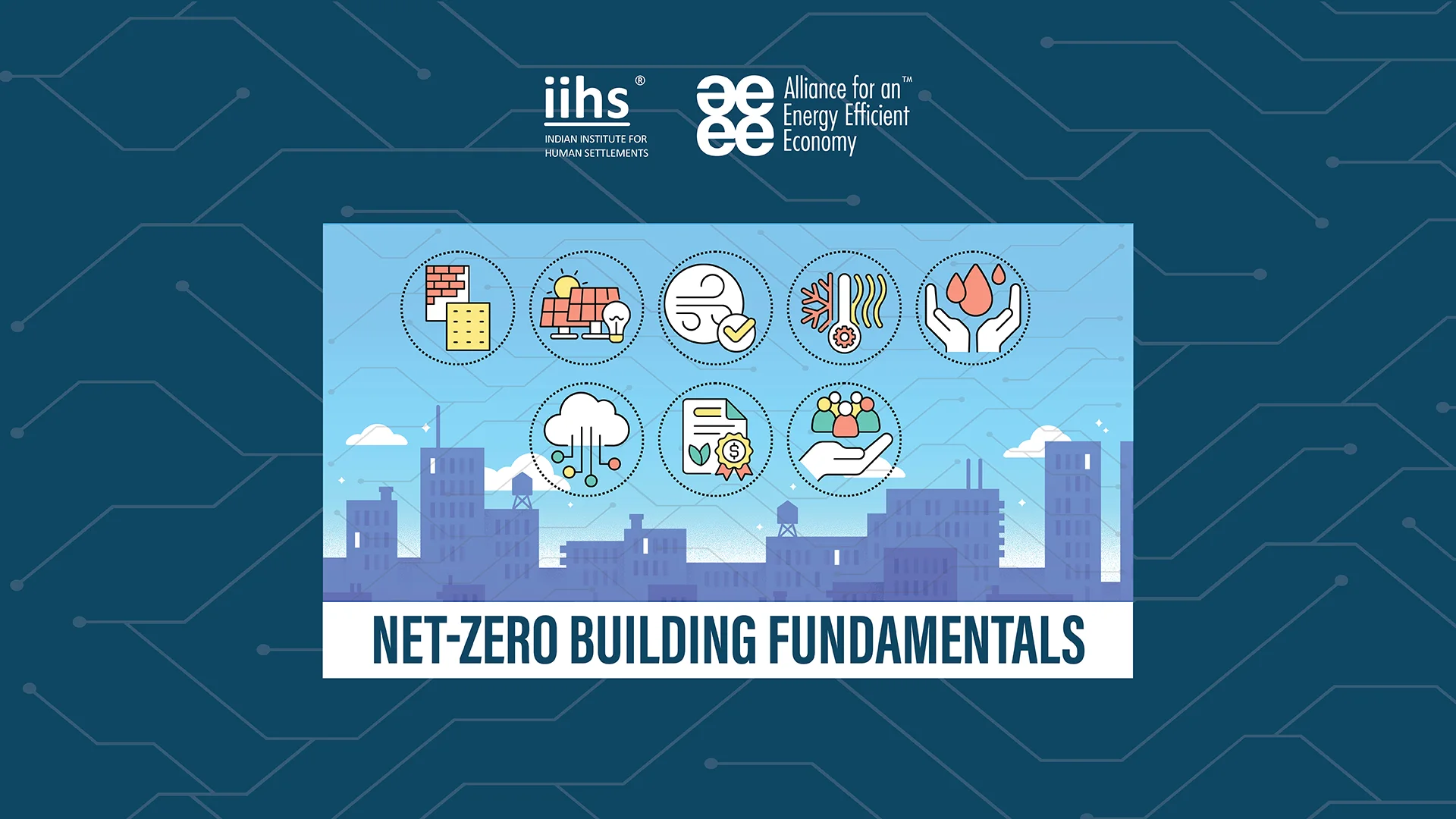
The course is jointly offered by the Alliance for an Energy Efficient Economy (AEEE) and the Indian Institute for Human Settlements (IIHS).
Interested learners can enrol for the course here or write to us at [email protected] for more information.
The course, Reimagining Education for Equity: Interrogating Policy and Practice (REE), examines the role of education in sustaining social inequalities in India and deliberates how education can be transformed to empower teachers and students to attain an equitable, just, and sustainable future. REE helps teachers engage with complex ideas relating to education, inequalities, and social justice that can help to make teaching and learning more equitable.
The REE course derives from the results of a four-year four-country research programme on ‘Transforming Education for Sustainable Futures’ or TESF. It is led by Professor Poonam Batra, a TESF co-investigator and one of India’s leading academics with four decades of interdisciplinary experience across elementary, higher, and teacher education practice and policy in India. Her work spans public policy in education; curriculum and pedagogy; social psychology of education; and teacher education and gender studies. This online course comprises 5 main modules, with each module requiring 5–8 hours of learning and reading time per week. It is designed to make TESF research and examples of transformational education accessible to practising teachers, student-teachers, the wider teacher education and policy community, and other stakeholders with an interest in education.
Interested learners can enrol for the course here or write to us at [email protected] for more information.